
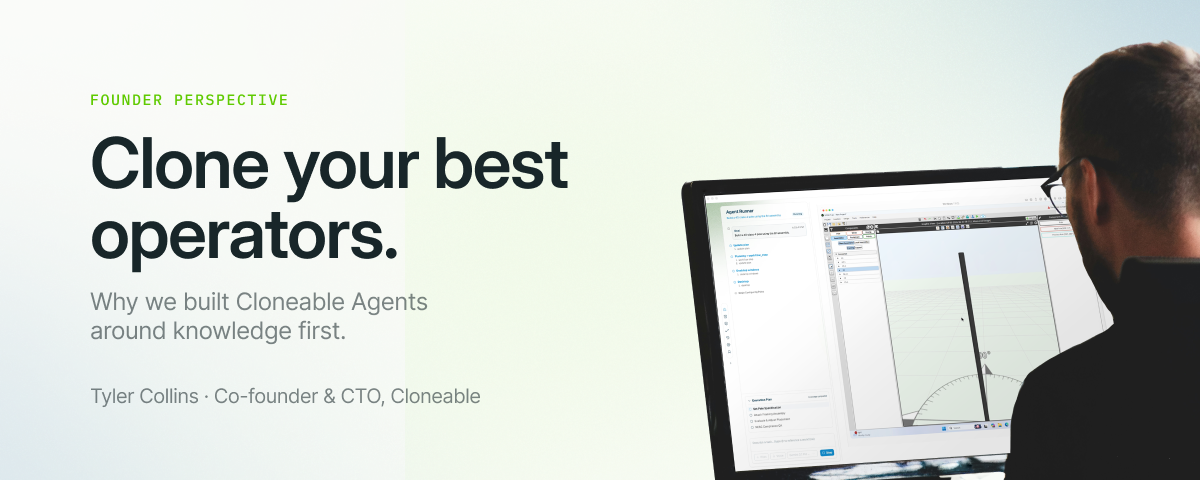
AI automation has an experience problem. Despite the rush to deploy AI agents across industries, most implementations stall not because the technology falls short, but because the institutional knowledge needed to run them was never captured in the first place. When critical business rules live inside a senior employee's head rather than any document, automating that work becomes nearly impossible.
The gap is especially acute in industries that touch the physical world. In utility engineering, for example, a make-ready sheet for PG&E in California operates under entirely different rules than one for Duke Energy in the Carolinas. The processes are genuinely complex with clearances, spacing tables, client-specific callouts, edge cases that senior designers just know and its spread across hundreds of pages that can't simply be handed to an AI on every run. When that person leaves, the expertise often goes with them.
However, it's not just knowledge that agents need to work. Experienced workers have years of proprietary business know-how, which they apply through legacy desktop software that's been highly customized to their company's and customers' workflows.
That is the problem Cloneable was built to address. Today, the company is launching Cloneable Agents, expanding on its core mission: turning hard-won human expertise into something scalable. The bet is that the bottleneck to useful AI automation isn't the models, it's the knowledge, experience, and existing software infrastructure underneath them.
Here’s how it works
Before the agent touches a job, the Agent Trainer watches an expert do the work.. It asks for the documents and context it needs, observes how the user navigates their software, and captures the reasoning behind each decision. Communication spacing rules. Vertical clearance tables. Regional code variations. Customer-specific output formats. The output is not a prompt. It is a workflow with defined phases, explicit inputs, expected outputs, and the reasoning behind every decision baked in before anything runs. That is what makes the difference between an agent that handles variation and one that fails the first time it sees a format it has never seen before.
The other thing most AI platforms get wrong is where they build. The assumption is that companies are running modern software stacks. In utilities, telecom, and infrastructure engineering, they are not. The tools are desktop-based, often on Windows, legacy, and they are not switching. SPIDAcalc. Katapult. ESRI. We built our agents to work inside those environments, not around them, because asking these companies to change their stack is not a real solution.
Our differentiation was never the infrastructure complexity. It is a decade of lived experience inside these industries and the proprietary workflows captured from being inside these companies. We train at the company level: one company, its rules, its industry, its tools. That specificity is what makes it cost-effective and what makes it work.
Why it works
Most agentic projects in enterprise fail at the POC stage, not because the technology doesn't work, and isn’t impressive. They fail because they don’t realize real value within the organization. While most agentic tools focus on categorizing emails, Cloneable Agent interviews you about your process, costs, structure; the bottom line that truly matters. Each agent run outputs what is important to you: cost per pole, time saved per job, cups of coffee saved. Define any metric and watch as it’s automatically tracked.
The firms that start capturing their knowledge now are the ones that will scale without limits on what their teams can accomplish.
— Tyler